Interpersonal style
Interpersonal Circumplex (IPC-32)
See where you sit on the interpersonal circle
Some people lead, some accommodate; some draw close, some keep their distance. This questionnaire places your everyday interpersonal style on a circle built from those two dimensions.
It shows your everyday interpersonal style, including how much you tend to take charge and how much warmth you bring to others.
For anyone who wants to see how they come across in everyday dealings with people.
Pay $6 before you start. The full report and PDF are included.
Your answers stay private.
It rests on interpersonal research that maps social behavior on two dimensions, dominance and warmth.
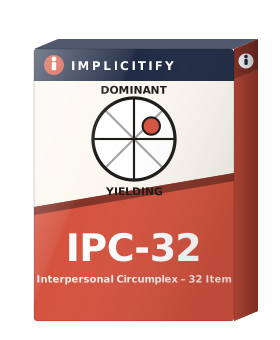
What this test is
Welcome. The public-domain International Personality Item Pool (IPIP) version of the Interpersonal Circumplex is a 32-item measure of interpersonal style across eight octants, from Assured-Dominant to Gregarious-Extraverted (Markey and Markey, 2009).
Map interpersonal style on the classic circle of Dominance and Warmth—eight octants in a brief IPIP form.
The measure
The Interpersonal Circumplex (IPC-32) was developed by Markey and Markey (2009). It has 32 items, each answered on a 5-point (Very inaccurate … Very accurate) scale. Its scores cover Assured-Dominant, Arrogant-Calculating, Cold-Hearted, Aloof-Introverted, Unassured-Submissive, Unassuming-Ingenuous, Warm-Agreeable and Gregarious-Extraverted.
Markey, P. M., & Markey, C. N. (2009). A brief assessment of the interpersonal circumplex: The IPIP-IPC. Assessment, 16(4), 352–361.
What you’ll learn
- How your style balances agency (taking charge) and communion (warmth toward others).
- Which of eight interpersonal styles, from Assured-Dominant to Unassuming-Ingenuous, are most and least like you.
- How your style scores compare with a community sample of adults.
- Whether your profile points clearly in one direction or is spread across several styles.
Structure
Read this figure as text
- Vertical dimension, agency: taking charge at the top, holding back at the bottom.
- Horizontal dimension, communion: warmth on the right, coldness on the left.
- Assured-Dominant: 4 items.
- Arrogant-Calculating: 4 items.
- Cold-Hearted: 4 items.
- Aloof-Introverted: 4 items.
- Unassured-Submissive: 4 items.
- Unassuming-Ingenuous: 4 items.
- Warm-Agreeable: 4 items.
- Gregarious-Extraverted: 4 items.
Read this figure as text
- Placeholder statement (not a real question): A statement about how you usually are with other people.
- Answer choices, in order: Very inaccurate, Moderately inaccurate, Neither inaccurate nor accurate, Moderately accurate, Very accurate.
- You choose the one answer that fits best for each statement.
- None of the items is reverse-keyed.
| Scale | Items | What it covers |
|---|---|---|
| Assured-Dominant | 4 | How confident, forceful, and take-charge you are with others. A higher standing: you tend to lead, assert yourself, and take charge readily. A lower standing: you tend to hold back from taking charge and to defer to others. |
| Arrogant-Calculating | 4 | How competitive, tough-minded, and self-promoting you are. A higher standing: you tend to be competitive and to look out for your own interests first. A lower standing: you tend to be modest and disinclined to play angles. |
| Cold-Hearted | 4 | How detached and unsentimental you are toward others. A higher standing: you tend to keep emotional distance and to stay business-like. A lower standing: you tend to be warm and emotionally engaged with others. |
| Aloof-Introverted | 4 | How socially reserved and inward you are. A higher standing: you tend to keep to yourself and to avoid the social spotlight. A lower standing: you tend to be outgoing and to seek out social contact. |
| Unassured-Submissive | 4 | How deferential and self-doubting you are with others. A higher standing: you tend to defer to others and to downplay your own wishes. A lower standing: you tend to be self-assured and ready to assert your views. |
| Unassuming-Ingenuous | 4 | How modest, trusting, and unpretentious you are. A higher standing: you tend to be modest, sincere, and trusting of others. A lower standing: you tend to be more guarded and less self-effacing. |
| Warm-Agreeable | 4 | How friendly, kind, and approachable you are. A higher standing: you tend to be warm, agreeable, and easy to get along with. A lower standing: you tend to be more reserved or cool in your dealings. |
| Gregarious-Extraverted | 4 | How sociable and outgoing you are. A higher standing: you tend to be lively, talkative, and drawn to company. A lower standing: you tend to prefer quieter settings and smaller groups. |
What it measures
Some people take charge in a group without thinking about it; others wait to be asked. Some respond to a stranger with immediate warmth; others keep a careful distance. The interpersonal circumplex describes these differences with two dimensions, dominance (from assured and assertive to unassured and submissive) and warmth (from cold and distant to warm and agreeable), arranged as the axes of a circle. Eight styles sit around it: Assured-Dominant, Arrogant-Calculating, Cold-Hearted, Aloof-Introverted, Unassured-Submissive, Unassuming-Ingenuous, Warm-Agreeable and Gregarious-Extraverted. Neighboring styles blend into one another, and opposite styles describe contrasting ways of relating.
The model traces to Leary (1957), who organized observations of interpersonal behavior in psychotherapy around the two axes, and was given its modern form by Wiggins (1979), who showed that trait words describing interpersonal behavior fall in a circular rather than a simple-structure pattern. The circular arrangement has since been used to integrate personality, psychopathology and psychotherapy research within a single interpersonal framework (Pincus and Ansell, 2003). The version used here is the public-domain form of Markey and Markey (2009), built from items in the International Personality Item Pool (IPIP).
Scores on the eight octants are combined into an overall position on the circle: a direction, which indicates the interpersonal style a person shows most consistently, and a distance from the center, which indicates how strongly the profile leans that way. A profile close to the center describes someone whose behavior varies with the situation; a profile far from the center describes a style that appears across many situations. No position is better than another in itself, although styles at the extremes may be harder to adjust when a situation calls for something different.
The circumplex is used in research on relationships, personality pathology and the process of psychotherapy, where it helps describe recurring patterns in how a person approaches others and how others tend to respond in turn. On this site it complements the Experiences in Close Relationships Short Form (ECR-SF), which describes attachment anxiety and avoidance in close relationships, the Rejection Sensitivity Questionnaire (RSQ), and the Core Conflictual Relationship Theme (CCRT), which reads relationship patterns from the stories people tell about their own interactions.
Nomological network
Factorially/circularly, the IPIP-IPC reproduces expected circumplex geometry. Convergently, it relates to peer ratings and to the IAS-R octants/axes (Markey & Markey, 2009). Discriminantly, adjacent octants correlate more than opposite octants, matching circumplex predictions rather than a single evaluative factor. Criterion and known-groups applications use the circle to locate interpersonal problems and styles.
This site’s International Personality Item Pool (IPIP) form
This version uses public-domain items from the International Personality Item Pool (Goldberg et al., 2006) keyed to the same dimensions.
Validity evidence
The International Personality Item Pool Interpersonal Circumplex (IPIP-IPC) shows good convergent validity with peer ratings and the Revised Interpersonal Adjective Scales (IAS-R), and the factor structure reproduces the expected circumplex geometry (Markey & Markey, 2009).
History and theory
Leary (1957) proposed the original circular ordering of interpersonal behaviors in Interpersonal Diagnosis of Personality. Leary’s circle identified eight interpersonal styles and described complementarity: when one person takes charge, the other person tends to give way, and people tend to meet hostility with hostility and warmth with warmth.
Wiggins (1979) formalized the model using factor-analytic methods and established agency and communion as its two fundamental axes. Wiggins showed that the circumplex could be derived from the trait-descriptive lexicon: adjectives describing interpersonal behavior organize into a circular structure when analyzed with appropriate methods.
Pincus, with Alden and Wiggins (1990), carried the circumplex over to interpersonal problems with circumplex scales for the Inventory of Interpersonal Problems, moving the model from style, meaning how someone characteristically behaves, to the aspects of interpersonal behavior that cause distress. Markey and Markey (2009) later developed the short public-domain version used here.
Clinical applications
How it works
| Format | A short questionnaire of statements about how you relate to people. |
|---|---|
| What you do | Say how well each statement describes you as you generally are. |
Test information
| Format | 32 short statements about you, answered one screen at a time |
|---|---|
| Answer scale | 5 points, from Very inaccurate to Very accurate |
| Pace | Self-paced |
| Structure | 8 scales, 4 items each |
| Scoring | Ratings are added up separately for each scale; none of the items is reverse-keyed |
| Administration | Online, on your own; clinicians and researchers can also assign it through a private link |
| Reference sample size | N = 600 to 795, depending on the scale |
| Source | Markey, P. M., & Markey, C. N. (2009). A brief assessment of the interpersonal circumplex: The IPIP-IPC. Assessment, 16(4), 352–361. |
| Purpose | Self-exploration, or assigned by a clinician. |
| Age range | Adults 18 and up. |
| Languages | English only. |
| Research samples | Most of the published research behind this measure comes from college student samples, so results should be interpreted with caution. |
How it is scored
Read this figure as text
- Step 1: You rate 32 statements
- Step 2: No statements need flipping
- Step 3: The four ratings for each style are added up
- Step 4: Eight style scores and a position on the circle
Evidence
- Published validity, agreement with the Interpersonal Adjective Scales warmth r = .82, dominance r = .75; matching styles median r = .58 (Markey & Markey, 2009, p. 358)
Sample report preview
The report places your interpersonal style on the circle formed by its two underlying dimensions, dominance and warmth. It first shows your standing on each of the 8 octants (Assured-Dominant, Arrogant-Calculating, Cold-Hearted, Aloof-Introverted, Unassured-Submissive, Unassuming-Ingenuous, Warm-Agreeable, and Gregarious-Extraverted), then summarizes the overall direction of your profile around the circle, and explains in plain language what that blend of assertiveness and warmth tends to look like in everyday interactions. It closes with notes on how to read the profile and on what a self-report of this kind can and cannot tell you.
What the report includes
Scores on all eight octants of the circle, from Assured-Dominant through Gregarious-Extraverted, with an overall dominance index and an overall warmth index, a plotted circumplex showing where your profile points, and short descriptions of four broader interpersonal styles: dramatic, clingy, withdrawn and antagonistic.
Because the model is a circle, your style is described as a location rather than a category: which direction you lean, and how strongly you lean that way.
| Section | What it shows |
|---|---|
| Style scores | Your score on each of eight interpersonal styles. |
| Circumplex diagram | Your profile drawn on the interpersonal circle. |
| Overall position | Where you sit on the two dimensions of taking charge and warmth, and how pronounced your style is. |
| Comparisons | How each style score compares with a community sample of adults. |
| Downloadable report | A copy of the report you can save. |
Illustrative
Read this figure as text
- Vertical dimension, agency: taking charge at the top, holding back at the bottom.
- Horizontal dimension, communion: warmth on the right, coldness on the left.
- Assured-Dominant: 4 items.
- Arrogant-Calculating: 4 items.
- Cold-Hearted: 4 items.
- Aloof-Introverted: 4 items.
- Unassured-Submissive: 4 items.
- Unassuming-Ingenuous: 4 items.
- Warm-Agreeable: 4 items.
- Gregarious-Extraverted: 4 items.
- Dashed arrow, illustrative example: the overall direction of one invented profile points toward warmth and taking charge. It shows direction only, not a score or a comparison with other people.
Good uses and limits
Good uses
- Describing your everyday, normal-range interpersonal style.
- Seeing whether your profile points clearly in one direction or is spread across several styles.
Not a good use
- A diagnosis or a clinical assessment.
- Decisions about other people, such as hiring, custody or admission.
- Reading meaning into one style score on its own: each style has only four items.
Scientific basis
The interpersonal circumplex arranges the ways people relate to one another around two dimensions: agency, or taking charge, and communion, or warmth. Markey and Markey (2009) developed the short public-domain version used here, with 32 items drawn from the International Personality Item Pool (Goldberg et al., 2006).
Because each of the eight styles is measured with only a few items, single style scores are less precise than longer scales, and the reliabilities in the reference sample are listed on this page. The overall shape of your profile is more informative than any one score.
Questions
Is this Wiggins’s Revised Interpersonal Adjective Scales (IAS-R)?
No. It is Markey and Markey’s (2009) International Personality Item Pool Interpersonal Circumplex (IPIP-IPC).
What validity evidence is primary?
Circular/circumplex structure across three studies and overlap with the adjective circumplex of the Interpersonal Adjective Scales (IAS) and with peer ratings (Markey & Markey, 2009).
References
- Wiggins, J. S. (1979). A psychological taxonomy of trait-descriptive terms: The interpersonal domain. Journal of Personality and Social Psychology, 37(3), 395–412.
- Wiggins, J. S., Trapnell, P., & Phillips, N. (1988). Psychometric and geometric characteristics of the Revised Interpersonal Adjective Scales (IAS-R). Multivariate Behavioral Research, 23(4), 517–530.
- Markey, P. M., & Markey, C. N. (2009). A brief assessment of the interpersonal circumplex: The IPIP-IPC. Assessment, 16(4), 352–361.
- Goldberg, L. R., Johnson, J. A., Eber, H. W., Hogan, R., Ashton, M. C., Cloninger, C. R., & Gough, H. G. (2006). The International Personality Item Pool and the future of public-domain personality measures. Journal of Research in Personality, 40(1), 84–96.
- Leary, T. (1957). Interpersonal diagnosis of personality. Ronald Press.
- Alden, L. E., Wiggins, J. S., & Pincus, A. L. (1990). Construction of circumplex scales for the Inventory of Interpersonal Problems. Journal of Personality Assessment, 55(3–4), 521–536.
Related measures
The test and full report with a downloadable copy are $6.
How would you like to use it?
For yourself
Take it yourself and receive a written score report you can download as a PDF. When you are signed in, your results are saved so you can retake it later and follow how your scores change over time.
For researchers
Sign up as an Implicitify researcher to use the full suite of measures in your studies, or pay for each test you give. Research pricing is still being set, so we will confirm it with you when you get in touch.
Become a researcherFor clinicians
Open a clinician account to send this measure to your clients or patients through a secure link and review their scored results in one place.
Create a clinician accountAlready have an account? Go to your clinician dashboard.For educators
Use our measures in your courses to show students how psychological assessment works and to teach the principles of testing.
Request course accessRelated tests
 Need to Belong ScaleMeasures how strongly you are motivated to belong and to be accepted by others.$5
 Rejection Sensitivity QuestionnaireMeasures how anxiously you expect, and how strongly you react to, rejection by others.$6
 Defense Mechanism QuestionnaireMeasures the habitual ways you protect yourself from stress and painful feelings, from mature to immature.$6
 Behavioral Inhibition and Activation ScalesMeasures sensitivity to punishment (behavioral inhibition) and to reward (behavioral activation).$6